
 Customer



Few names cause as much debate in the heavy-duty truck world as the Ford 6.4 Power Stroke. Navistar made this engine for Ford, and it is mostly found in the 2008 Ford F250 6.4 diesel and its F350/F450 siblings. They designed it to be a powerhouse. But it also marked the beginning of a new era of complexity that would change the diesel landscape forever.
If you are a current owner or considering a used 2008 F250 diesel, you need to understand the nuances of the 6.4L Power Stroke to survive.
The 6.4L Power Stroke was Ford’s answer to the controversial 6.0L and was introduced in 2008. Ford’s answer to tougher EPA emissions requirements is adding the diesel particulate filter (DPF) to the Super Duty range.
Under the hood, the 6.4 Powerstroke engine is a technological wonder. It has a sequential twin-turbocharged setup that essentially eliminates turbo lag. It makes a huge 350 horsepower and 650 lb-ft of torque available right off the showroom floor. It was different from its predecessor in that it used a high-pressure common-rail fuel system with piezoelectric injectors, which meant it could be quieter and deliver fuel more precisely.
If you’re looking into 6.4 Power Stroke years to avoid, unfortunately, the answer is a bit more complicated. The engine was only produced for three model years, 2008, 2009, and 2010.
So technically, the 2010 models had the fewest amount of “growing pains.” But all three years have the same basic design. The 6.4 Powerstroke reliability was inconsistent throughout its life; the production run was so short. Most enthusiasts agree that if you buy one today, the maintenance history is far more important than the particular model year.
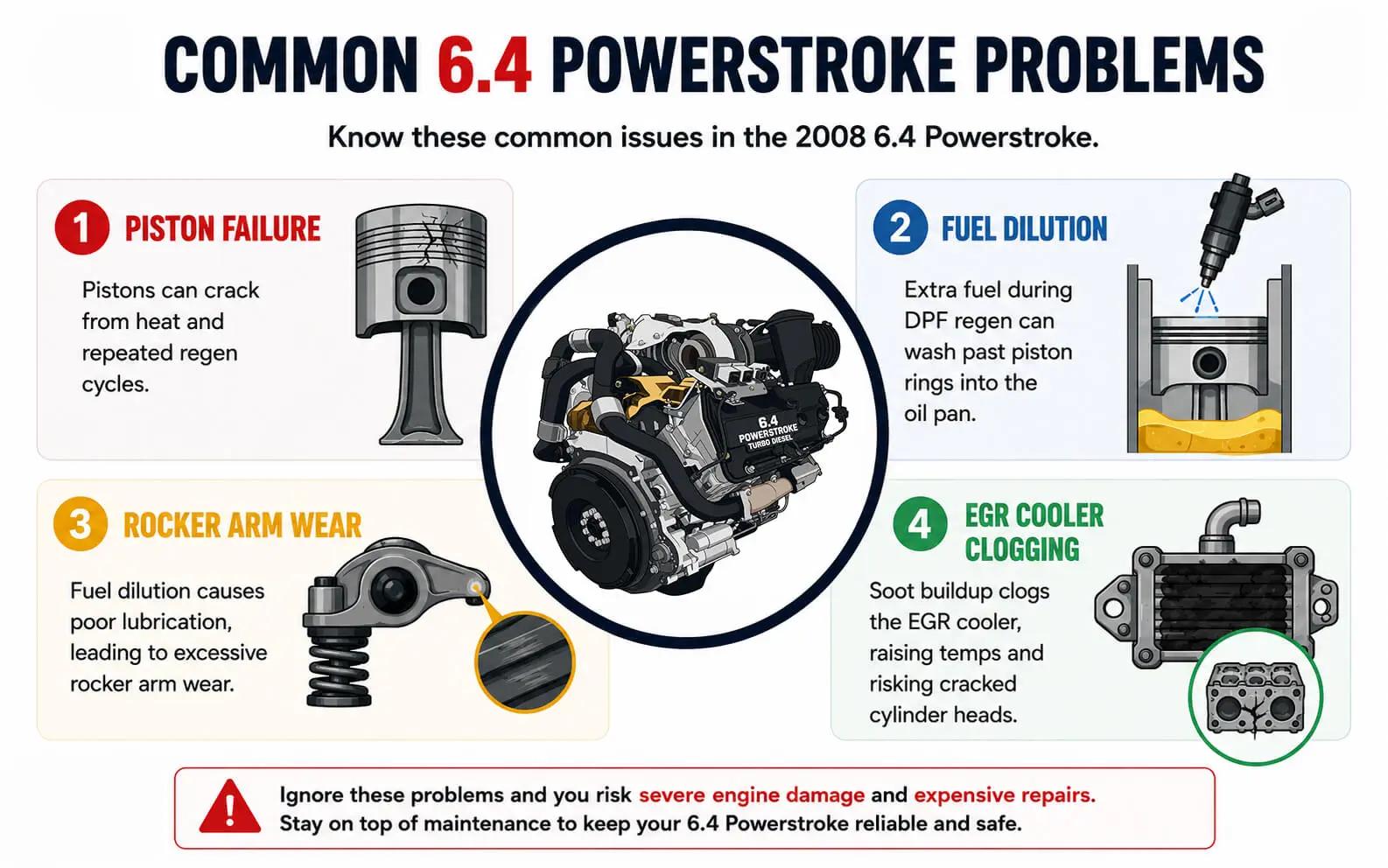
One can easily be fooled into a false sense of security, given the enormous towing capacity of the 6.4 Powerstroke. Still, 6.4 Powerstroke problems are so extensive that they are downright dangerous if not addressed. If you own a 2008 6.4 Powerstroke, be aware of what comes next:
Due to the fuel dilution problems, you have to realize that maintenance makes the 6.4 Powerstroke reliable. You simply cannot run this truck like a gasoline engine; you have to be disciplined. The Powerstroke uses 15 quarts (3.75 gallons) of oil in the 6.4 L Powerstroke.
Though the brochure recommends longer mileage intervals than what is typically used, most diesel mechanics advise changing the oil after 5,000 miles or sooner if the engine is frequently in “regen” mode. You should use a top-notch 15W-40 or 5W-40 synthetic diesel oil.
Desperate for the longevity and durability of a 6.4 Powerstroke, you might think, “Why doesn’t everyone buy one?” The key point is performance. The 6.4L Powerstroke is generally considered the easiest diesel engine to make insane power with. With a cheap electronic tuner, exhaust system, and maybe a pipe on the intake, these trucks will go from running 350hp to well over 500hp. The monster midrange torque of the compound turbos, and these trucks become a favorite for the sled pulling and heaviest highway towing jobs out there, so long as their internals don’t give in.
So, is the 6.4 PowerStroke motor a “ticking time bomb”? Not really, but it is a “high-maintenance” motor. To maximize the life of your Ford 6.4 Powerstroke, you must:
The 2008 6.4 Powerstroke is a somewhat exclusive period for Ford. This phase was a basic transitional period between the old-school diesel tech and the current 6.7L Scorpion engine. Comfort- and reliability-wise, the 6.4 Powerstroke is no legend, but it is known for power.
If you are researching a 2008 Ford F-250 6.4 diesel, go in with your eyes wide open. The 6.4 is amazing on the highway if you have fresh oil, a clean fuel system, and monitored gauges.